Evidence Window
A case opens with one clue. Commit an answer now for full points, or ask for the next clue and take less. Every clue makes the answer clearer and worth less, so waiting until you are certain is always available and always the cheapest outcome. Wrong answers pay nothing at any stage. Six looks ship with it — the activity’s own, plus a beach, a card room, an arcade, a glasshouse and a summit, each drawn in the file itself with no images to load. Switch mid-session from the masthead; a saved copy keeps the one you chose.
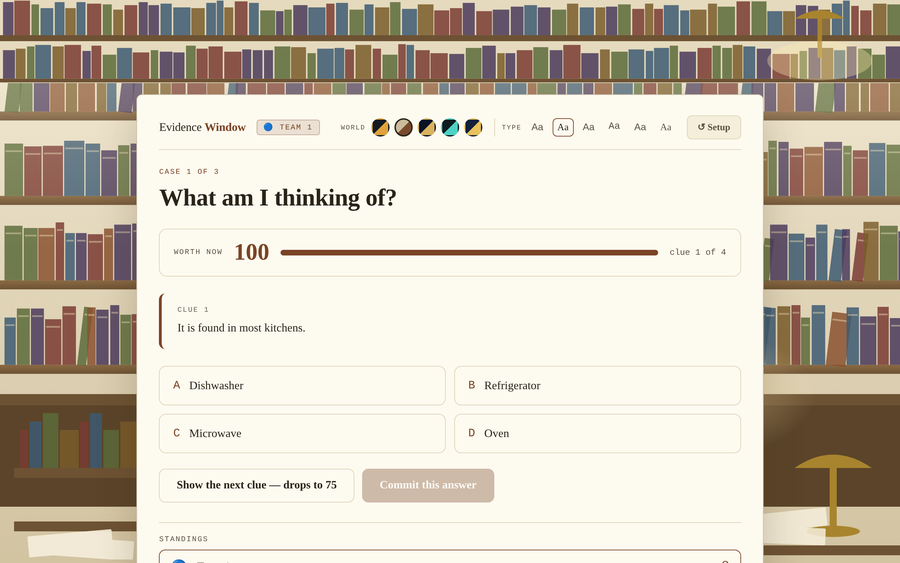
- Problem
- Training rewards being right. Real work rewards being right soon enough — a correct diagnosis after the caller has hung up is not a win. Nothing in a normal quiz puts a price on hesitation, so the cost of waiting for certainty never becomes visible.
- Who it helps
- Teams doing diagnostic or investigative work — troubleshooting, claims review, escalation triage — where the skill being developed is recognizing a pattern before all the evidence is in.
- In training
- The closing screen reports the earliest clue anyone committed on. That is the number worth discussing: ask the team what they saw at clue one that everyone else waited three clues to be sure about.
- Skills shown
- Decaying-value scoring, progressive disclosure, state machine design, comparative team scoring, assessment design, in-browser editing with persistent export.
How to edit
- Click Edit this activity in the corner.
- Write each case as a title plus four clues, ordered from least to most revealing. That ordering is the whole design — clue one should be gettable but hard.
- Set the four answer options and mark which is correct.
- The why shows after the reveal and is where the teaching happens — explain what made the answer findable early.
- Click Save my version for a copy with your cases built in.