Triage
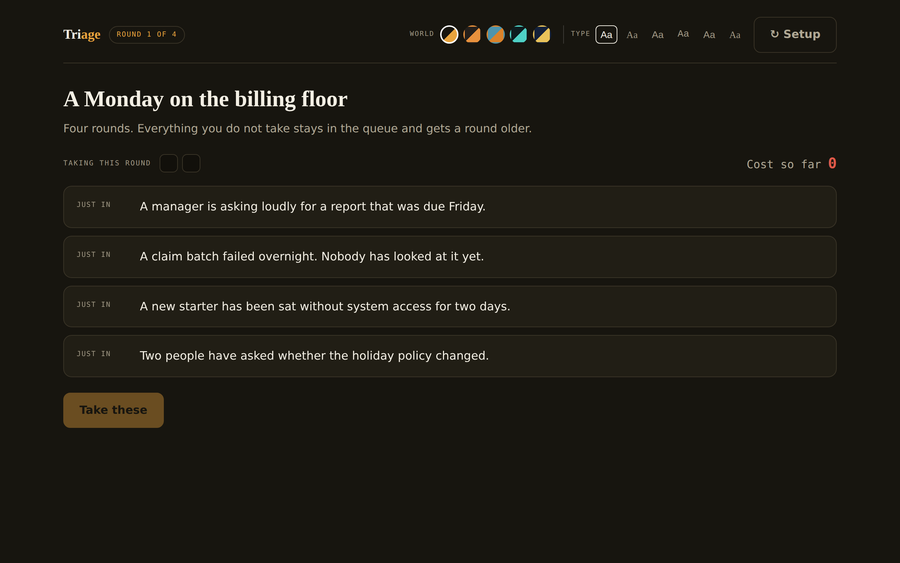
More work arrives than the room can take. Each round they pick a couple of items to handle and everything they leave stays in the queue and gets a round older — which is where the whole activity lives. What each item costs is hidden while choosing and revealed after, because a description and how long it has waited is all anyone gets in the real version. Some things get worse waiting, some get cheaper, and a few sort themselves out, so handling those early is a real mistake that felt like good work. The debrief compares what the room paid against the cheapest that was actually available and names the item that hurt most. Five looks ship with it — the activity’s own, plus a kitchen pass, a harbour, a control room and a winter market, drawn in the file itself with no images to load.
- Problem
- Prioritisation is normally taught with a matrix, and a matrix quietly implies the right answer was knowable at the moment of choosing. It was not. People do not fail at this because they cannot rank things — they fail because the loudest item is in front of them and the expensive one is silent.
- Who it helps
- Operations, billing, patient access and support teams who work a queue, and team leads deciding what their people work on next.
- In training
- Make them argue out loud before committing, and write the reasoning on a whiteboard — the debrief is much stronger when you can point at what they said at the time. Run it twice with different capacities if you have the session length: the same queue at one item per round teaches something quite different from three. Finish on the item flagged as costliest and ask what could have told them, at that moment, that it was the one.
- Skills shown
- Prioritisation activity design, hidden-cost modeling with ageing curves, opportunity-cost scoring against a reachable optimum, live queue simulation, in-browser editing with persistent export.
How to edit
- Click Edit this activity in the corner.
- Each item has the round it arrives, a costs array, and a note explaining what actually happened.
- Costs is the design. Entry n is what it costs handled in round n+1; the last entry is what it costs if never handled at all.
- Rising numbers mean it worsens waiting. Falling numbers mean waiting was right. A zero means it resolved itself — include at least one of those.
- Write one item that looks urgent and is not. That is the one the debrief will be about.
- Click Save my version for a copy with your queues built in.