Trade Floor
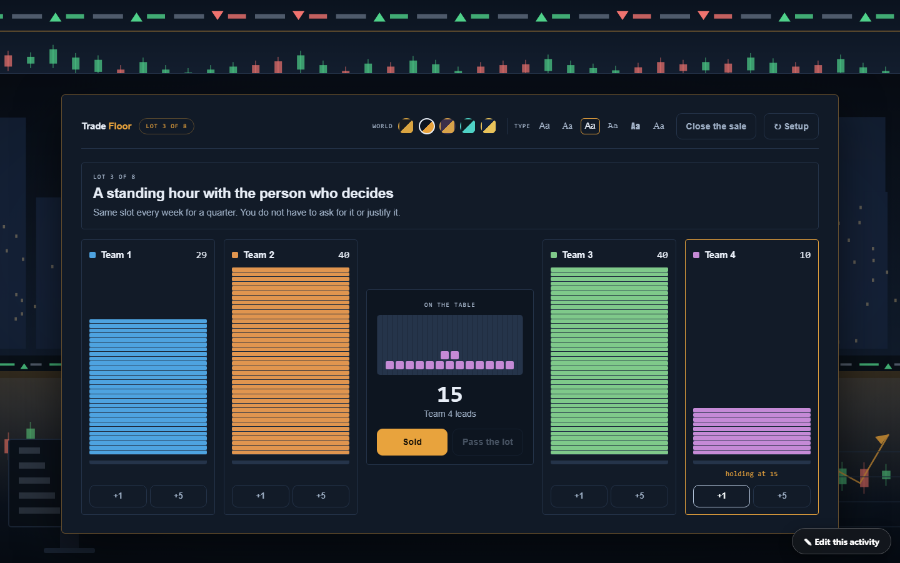
Four teams, the same budget each, and a list of things every one of them wants. One lot at a time, highest bid takes it, and what you pay is gone. The whole game is on the stage rather than in a scoreboard: four reserve stacks stand around a central tray and a stack’s height is that team’s remaining budget, drawn linearly and exactly, so the room reads the state of play without reading a number. Bids travel out of a tower and into the tray; a losing bid travels home again; a winning bid drops into the tray and is gone, and the winner’s tower stays permanently shorter. Run low and the blocks thin until the plinth shows through the gaps — no red, no banner, just visible emptiness. Five looks ship with it — the activity’s own, plus a trading floor, an assembly hall, a control room and a winter market, drawn in the file itself with no images to load.
- Problem
- Ask a team to rank what it wants and everything comes back important, because ranking on paper costs nothing. Priorities only become real when they are paid for out of one pot, and most groups never have to do that in a room — so the trade-off gets made later, quietly, by whoever controls the budget, and nobody learns what anybody was actually willing to give up.
- Who it helps
- Team leads and managers negotiating for shared resource, groups being taught prioritisation or trade-off thinking, and anyone who has to explain why a request was declined when the reason was cost rather than merit.
- In training
- Say the lot out loud and then wait. The pause where nobody wants to open is the activity working, and filling it is the one way to spoil it. Do not comment on a team spending early; let the tower do it. The debrief question is not “who won” — it is “which lot did you want and not bid on”, because that is a price somebody set on something out loud, and it is the only part of this that transfers straight to a real decision.
- Skills shown
- Auction mechanics as a teaching device, state made physical rather than numeric, motion used to teach a rule, linear encoding of quantity to height, in-browser editing with persistent export.
How to edit
- Click Edit this activity in the corner.
- Each lot needs a name and a note. The note is the concrete thing it changes on a Monday.
- The lots have to be genuinely wanted. One nobody bids for is dead air; one everybody must have is just a tax.
- Order matters. Never put the best lot first — the activity is about the lots you have not seen yet, and if the best one opens the sale there is nothing left to regret.
- Rename the teams to match the room if that helps them argue.
- Click Save my version for a copy with your lots built in.