Show of Hands
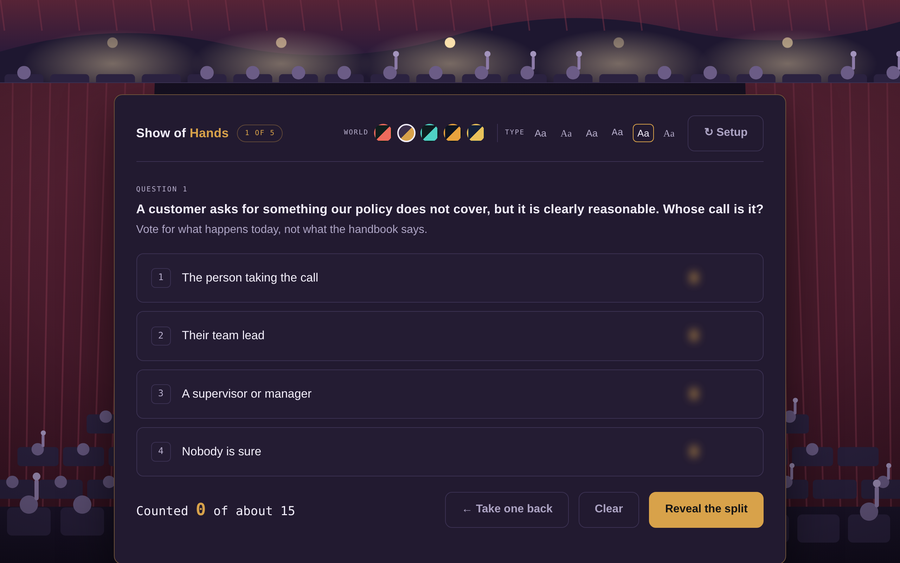
A poll with no right answer, built for what happens after the count. A question goes up, hands go up, and you tally with the number keys — one press per hand, no join code and no second screen. The bars stay hidden while you count, so nobody adjusts their vote once they can see which way the room is leaning; press reveal and the split lands all at once, alongside the question worth asking about it. Runs entirely offline from a file. Six looks ship with it — the activity’s own, plus an assembly hall, a control room, a trading floor and a winter market, each drawn in the file itself with no images to load. Switch mid-session from the masthead; a saved copy keeps the one you chose.
- Problem
- A room that assumes it agrees usually doesn’t, and the disagreement stays invisible because nobody counts it. Asking “everyone clear?” returns silence whether people are clear or lost. A quiz can’t help here either, because the questions worth asking — whose call is this, what would you actually do — have no correct answer to score.
- Who it helps
- Facilitators opening a session, teams aligning on process ownership, and anyone running a retro or a policy walkthrough where the useful information is where people differ.
- In training
- Leave it on blind until reveal. Watching the bars grow changes how people vote, and the late votes drift toward whichever option is already winning. Count first, reveal once, then work the widest gap — the tool surfaces a prompt for exactly that, and it is the whole activity. The wrap-up screen keeps every split from the session so you can point back at the one that mattered.
- Skills shown
- Facilitation tooling, anchoring-resistant polling design, keyboard-first interaction for live use, offline-first architecture, in-browser editing with persistent export.
How to edit
- Click Edit this activity in the corner.
- Each question needs 2–6 options and a talk line — the thing to ask once the split is on screen.
- Write questions that genuinely divide a room. If you can guess the answer, it will not produce a conversation.
- The talk line is the tool; the count is only how you get there. Aim it at the gap, not the winner.
- Click Save my version for a copy with your questions built in.