Ripple
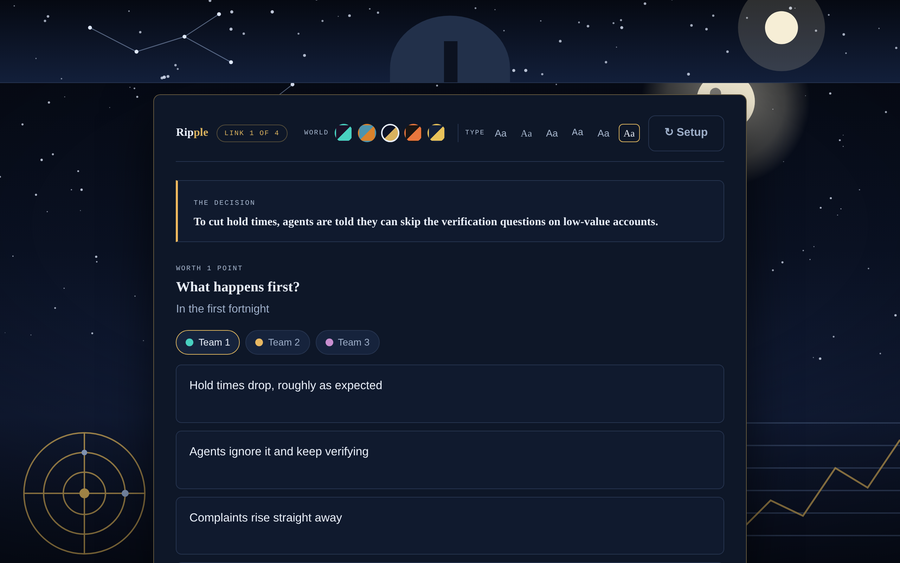
A decision goes up — one that already happened somewhere — and the room predicts what it causes. Reveal, then predict the next link from what actually happened rather than from the guess, four links deep, with the later ones worth more because almost anyone can see one step out. The chain does not fork on a wrong answer, so missing link two costs nothing at link three; that separates being wrong once from having the wrong model of the system. The debrief names the first link nobody called. Five looks ship with it — the activity’s own, plus a harbour, an observatory, a campfire and a winter market, each drawn in the file itself with no images to load.
- Problem
- People are good at first-order consequences and poor at third-order ones, and nothing in a normal review surfaces the difference. A decision gets judged on the fortnight after it lands, which is exactly the window where a bad decision still looks like a good one — the early signal says it worked.
- Who it helps
- Operations, quality and process teams reviewing a change before or after it ships, and anyone teaching how a policy travels through a system rather than what the policy says.
- In training
- Do not correct a team that guessed wrong — the chain carries on from the real outcome and they get the next link at full value, which is the whole design. Spend the time on the why line under each link, because that is where the reasoning lives; the option text alone teaches nothing. Finish on the first link the room missed and ask what would have had to be true for someone to call it.
- Skills shown
- Systems-thinking activity design, second and third-order consequence modeling, non-branching prediction scoring, progressive chain reveal, in-browser editing with persistent export.
How to edit
- Click Edit this activity in the corner.
- A chain needs a decision and four links. Each link has a when, a question, its options, the index of what actually happened, and a why.
- The why is the activity. It has to explain why the obvious prediction was wrong — if it could be guessed from the answer, the link teaches nothing.
- Make the wrong options genuinely plausible. One obviously silly option turns a four-way choice into a three-way one.
- Click Save my version for a copy with your chains built in.