Red Team
A plan goes up — a reasonable one, which is the point — and teams take turns naming a way it fails. You type what they say and rate it in a single click, how likely against how bad, and it plots on a risk grid in front of the room. Anything already said scores nothing, so the second team has to think past the obvious. What you keep at the end is the room’s risk grid rather than the author’s: their failure modes, ranked, with the worst one pulled out and a prompt for what would have to be true for it not to happen. Five looks ship with it — the activity’s own, plus a control room, a workshop, a trading floor and a winter market, each drawn in the file itself with no images to load.
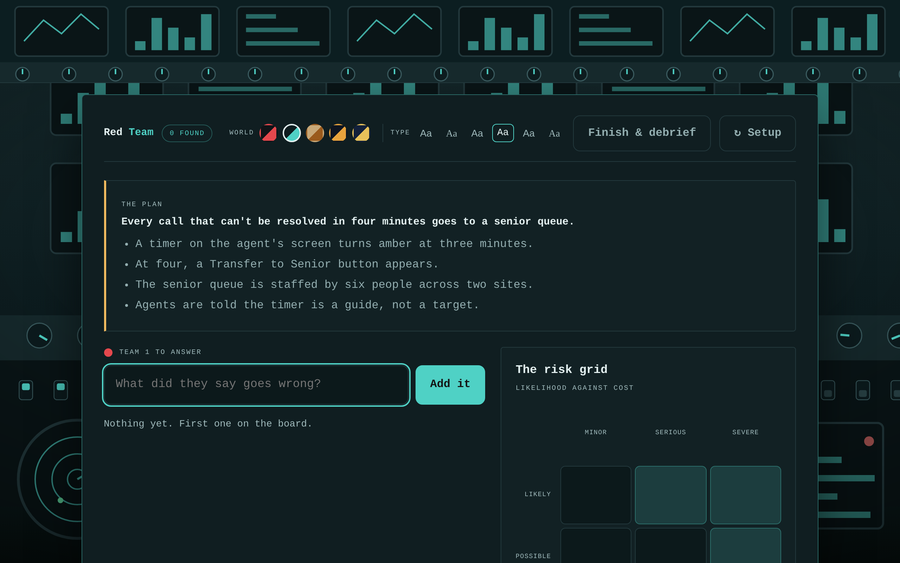
- Problem
- Asking a room “any concerns?” gets you the first obvious risk and then silence, because there is no reason to keep going and some cost to being the person who keeps objecting. The failure modes worth knowing are the second and third ones, and nothing in a normal review meeting reaches them.
- Who it helps
- Teams reviewing a rollout, a policy change or a new process before it ships — operations, quality, onboarding, or anyone who will have to live with the plan they are being shown.
- In training
- Do not use the seeded risks early. A room handed one stops looking for its own, and the seeds exist only to restart a room that has genuinely stalled. Rate honestly in front of everyone, including rating something low — if every contribution scores well the grid stops meaning anything. Finish on the top-right cell and ask what would have to be true for it not to happen, not how you would recover from it.
- Skills shown
- Generative activity design, live facilitator capture, weighted risk scoring, likelihood-against-cost plotting, keyboard-first interaction for live use, in-browser editing with persistent export.
How to edit
- Click Edit this activity in the corner.
- A plan needs a title, a few bullets describing it, and seeds you can drop in only if the room stalls.
- Make the plan genuinely reasonable. A straw man teaches nothing — everyone finds the deliberate flaw and stops.
- Write the bullets as decisions already made, not as questions. The room has to argue with something concrete.
- Click Save my version for a copy with your plans built in.