Other Side
A proposition with two defensible sides, and the tool assigns them — visibly at random, so nobody can say they were put where they already stood. Each side builds its case, with prompts if it stalls. Then the part that matters: each side states the other side’s strongest argument, and the other side marks whether that was a fair statement of it. Nobody wins by arguing better. The only thing scored is whether the people you disagreed with recognized their own position in your description of it. Five looks ship with it — the activity’s own, plus an assembly hall, a card room, a trail junction and a winter market, drawn in the file itself with no images to load.
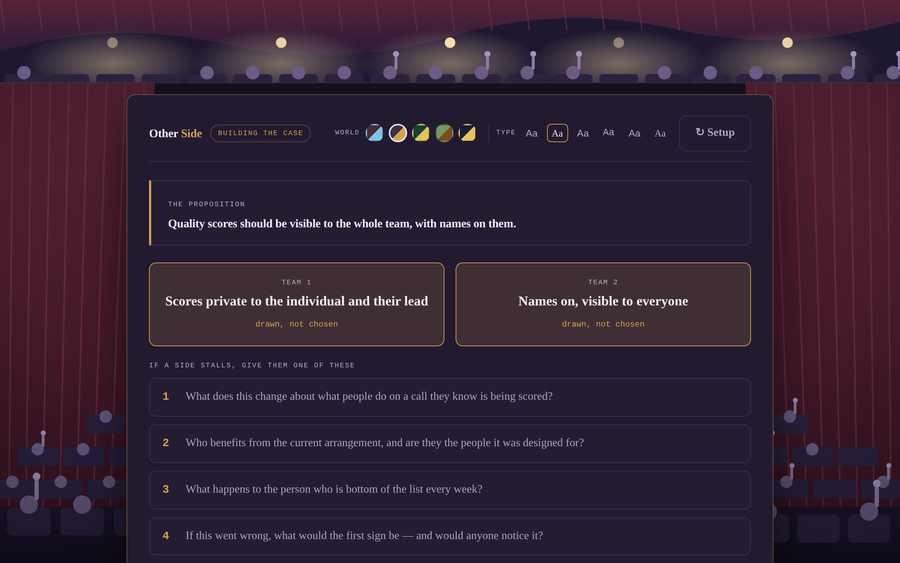
- Problem
- Long-running disagreements are usually between two people arguing with a version of the other’s position that nobody actually holds — the weakest version they have heard someone say. Nothing in normal working life ever tests whether you could state the other case fairly, and a debate format makes it worse by rewarding the opposite.
- Who it helps
- Teams stuck on a recurring disagreement, leaders preparing for a contested change, and anyone teaching disagreement as a skill rather than a problem to be avoided.
- In training
- Do the draw with everyone watching — it is what stops this becoming a debate about who believes what. Be ready for nobody’s view to move, and say so before you start: understanding a case is not the same as being persuaded by it, and conflating the two is exactly why people avoid doing this. The most useful outcome is the common one, where one side was heard and the other was not.
- Skills shown
- Steelmanning activity design, representation-based scoring judged by the represented side, visible randomised assignment, facilitation scaffolding, in-browser editing with persistent export.
How to edit
- Click Edit this activity in the corner.
- Both sides must be genuinely defensible by a reasonable person. If one side is obviously right this collapses into a lecture.
- Keep the prompts neutral — they get handed to whichever side stalls, so they cannot favour either.
- Write claims the room actually argues about. A proposition nobody has a stake in produces a polite exercise and no heat, and the heat is what makes the fairness test mean anything.
- Name the sides in the words the room would use, not in the words a policy would use.
- Click Save my version for a copy with your propositions built in.