Order of Operations
The steps of a real process arrive shuffled. Every one genuinely belongs — the only question is what comes first. Scoring is positional, so getting five of seven in place reads as five of seven rather than a failure, and each wrong row tells you where that step actually goes. Six looks ship with it — the activity’s own, plus a beach, a card room, an arcade, a glasshouse and a summit, each drawn in the file itself with no images to load. Switch mid-session from the masthead; a saved copy keeps the one you chose.
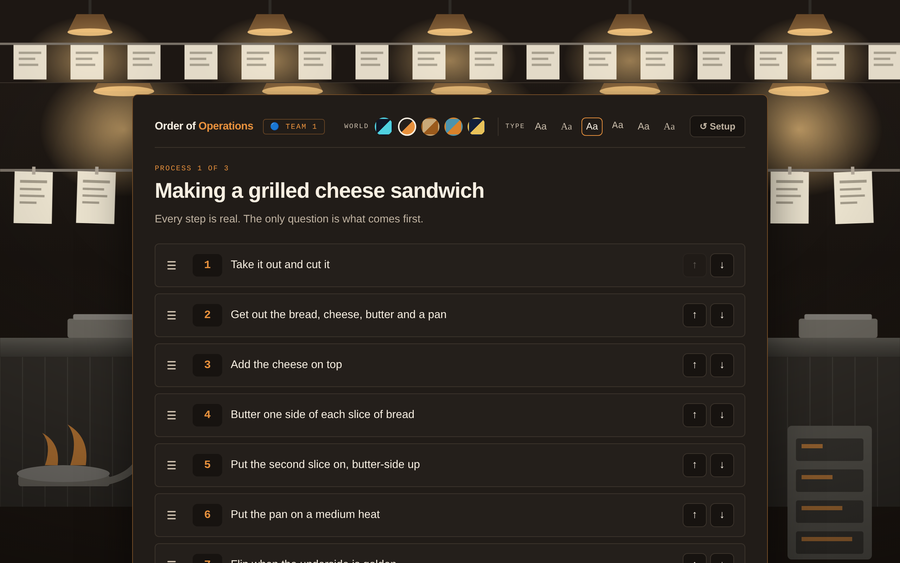
- Problem
- Most people can list the steps of a process they run daily. Far fewer can order them, because the wrong order usually still works — right up until the edge case where it does not. Verifying identity before discussing an account and verifying it after are both procedures. One of them is a breach.
- Who it helps
- Any team running a documented process where sequence carries risk — verification, claims work, escalation, onboarding.
- In training
- The reveal explains why the order is what it is, which is the part worth keeping. The near-misses are more useful than the perfect scores: walk back through which step everyone moved too early and you will usually find the same one.
- Skills shown
- Sequencing logic, positional scoring, guaranteed-nontrivial shuffle, list reordering UI, process analysis, in-browser editing with persistent export.
How to edit
- Click Edit this activity in the corner.
- Write each process as a name, a short note, and its steps in the correct order — the tool shuffles them for you.
- Every step should genuinely belong. The difficulty comes from ordering real steps, not from spotting a fake one.
- The why is the teaching. Explain what breaks when a specific step moves — that is what people take away.
- Click Save my version for a copy with your processes built in.