Odd One Out
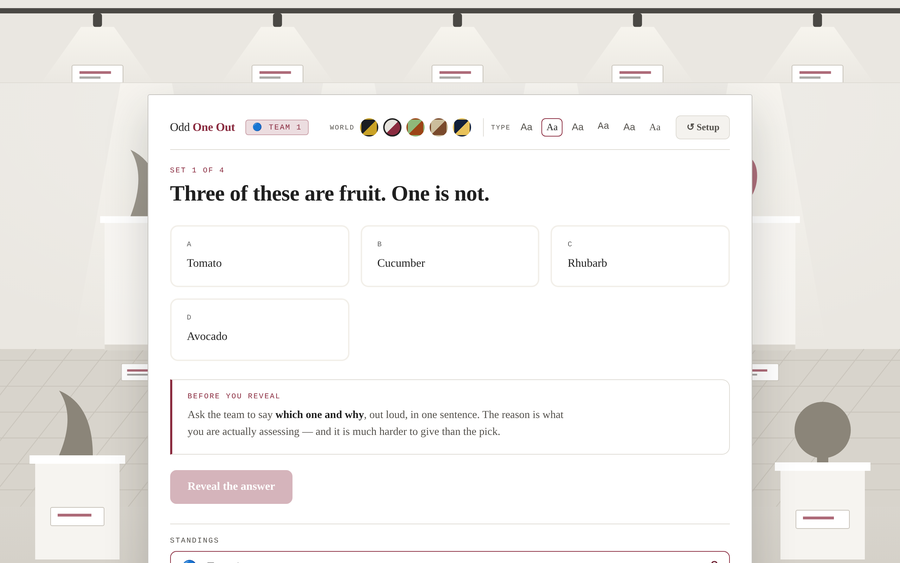
Four cases. Three share something, one doesn’t. Scoring is two-part on purpose: a point for the right pick, and a second the facilitator awards only if the reason given matches the actual rule. You can be right for the wrong reason, and the score will say so. Every distractor has a genuine case for it. Six looks ship with it — the activity’s own, plus a beach, a card room, an arcade, a glasshouse and a summit, each drawn in the file itself with no images to load. Switch mid-session from the masthead; a saved copy keeps the one you chose.
- Problem
- Spotting that something is different is easy. Naming the rule that makes it different is the actual skill — the gap between “that claim looks odd” and “that claim is outside the filing window”. Multiple choice cannot tell those apart, because both produce the same click.
- Who it helps
- Teams doing review, audit, or quality work where the job is noticing the one case that does not fit — claims review, chart audit, QA sampling, coaching call selection.
- In training
- Ask for the reason out loud before you reveal — the tool prompts for it and then hides the prompt, so the sequence is enforced. The closing screen counts correct picks made without a matching reason, and those are the ones to walk back through: being right without knowing why does not survive the next case.
- Skills shown
- Distractor design, two-part scoring with facilitator judgment, pattern-recognition assessment, comparative card UI, in-browser editing with persistent export.
How to edit
- Click Edit this activity in the corner.
- Each set has four items and one odd index (0–3 — the first item is 0).
- The hard part is the three that belong: make them vary in ways that look significant but aren’t. If only one item differs at all, there is nothing to argue about.
- Write the rule as the actual reason, and distractors as why the wrong picks tempt people. That second field is what makes the debrief work.
- Click Save my version for a copy with your sets built in.