Load Bearing
A brief, a pile of parts, and fewer slots than parts. Build the thing — a shift handover, a job aid, a first week — then real situations arrive one at a time and each either holds or gives way. Every part is genuinely useful; none of them are junk. The mistake available is picking two that cover the same situation, which feels thorough and is the opposite: a slot spent twice on one risk while another sits uncovered. The debrief names that pair, and compares your coverage against the best any build of that size could have reached, found by enumerating every combination. Five looks ship with it — the activity’s own, plus a workshop, a harbour, a summit and a winter market, drawn in the file itself with no images to load.
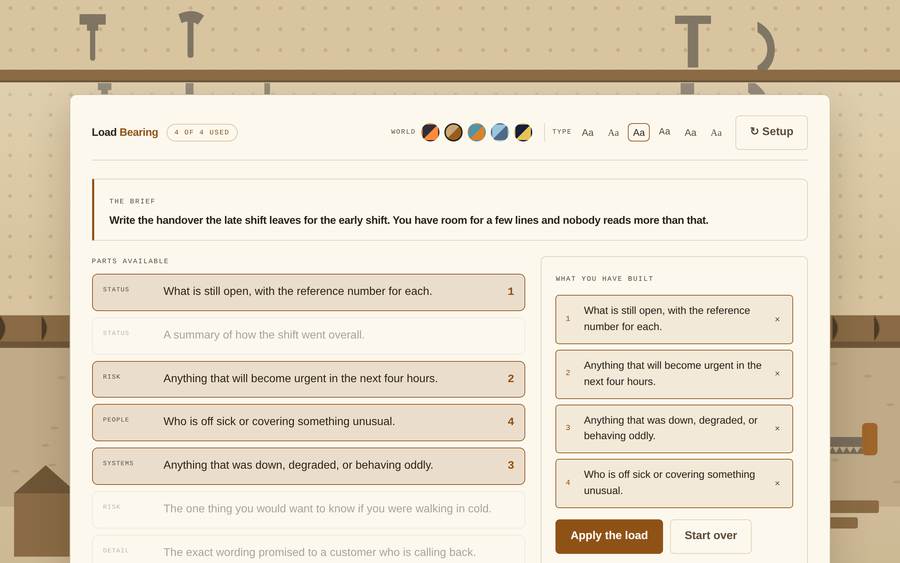
- Problem
- Checklists, handovers and job aids fail on what was left out, and the thing left out is rarely obvious at the time — it loses its place to a second item covering ground that was already covered. Nobody notices until the situation nobody planned for turns up, and by then the document has been in use for months.
- Who it helps
- Teams writing handovers, job aids, checklists or onboarding plans, and anyone being taught to design for coverage rather than for completeness.
- In training
- Make them say what each part is for before it goes in the build. Two answers that match is the moment the activity exists to produce, and it lands far harder coming from the room than from the debrief screen. Run it twice at different slot counts if you have the time — the same brief at three parts is a different conversation from five, because at three there is no build that covers everything and the argument moves to which failure you accept.
- Skills shown
- Coverage modeling, redundancy detection across a chosen set, exhaustive combination search for scoring against a real optimum, staged consequence reveal, in-browser editing with persistent export.
How to edit
- Click Edit this activity in the corner.
- Each part lists which situations it covers. Every part must cover at least one — there are no decoys here, that is Redline’s job.
- Make some parts overlap deliberately. The redundant pair is the trap, and it has to be a plausible pairing or nobody falls for it.
- Each situation needs a note explaining what happens when nothing in the build covers it. Write the consequence, not the rule.
- Check the numbers: if every situation is covered by three different parts, there is no decision to make.
- Click Save my version for a copy with your briefs built in.