Knock-On
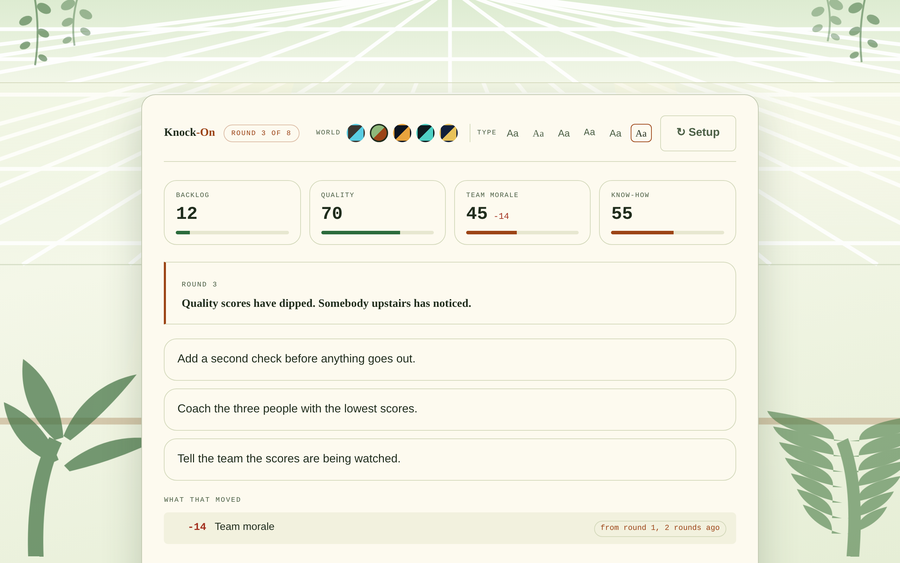
Four numbers describing a team, and eight rounds of decisions that genuinely change them. Some of what a choice does lands immediately. Some arrives two or three rounds later — and when it does, the tool says which round it came from, which is the one piece of information nobody has in real life. Two rooms running the same eight rounds finish somewhere different, and the trajectory chart at the end is theirs rather than the author’s. Five looks ship with it — the activity’s own, plus a glasshouse, a trading floor, a control room and a winter market, drawn in the file itself with no images to load.
- Problem
- A cost that arrives immediately gets attributed correctly. A cost that arrives three rounds later gets blamed on whatever else was happening that week. That is why organizations repeat decisions that plainly did not work — by the time the bill turns up it looks like a different bill, belonging to a different cause.
- Who it helps
- Team leads, operations and change managers, and anyone being taught that a decision has a tail — particularly people who have only ever been measured on the quarter a choice was made in.
- In training
- Have them predict the numbers before each choice and write the prediction where everyone can see it. Being wrong about an immediate effect is uninteresting; being wrong about a delayed one is the whole session. Run it twice with different groups making different choices and put the two trajectory charts side by side — same eight rounds, different endings, is a more convincing argument than anything you could say about it.
- Skills shown
- State simulation with scheduled delayed effects, attribution labelling, SVG trajectory chart generated from live state, systems-thinking activity design, in-browser editing with persistent export.
How to edit
- Click Edit this activity in the corner.
- Each option carries a list of effects. An effect is a metric, an amount, and in — how many rounds until it lands.
- In: 0 lands now. In: 2 lands two rounds later, and the tool tells the room where it came from.
- Write at least one option that is clearly good now and carries a large delayed cost. Every room takes it, and the moment it lands is why the activity exists.
- Do not make delayed effects always bad. If patience is always rewarded the room learns “never take the quick win”, which is just as wrong as the thing you are correcting.
- Click Save my version for a copy with your scenarios built in.