Close Enough
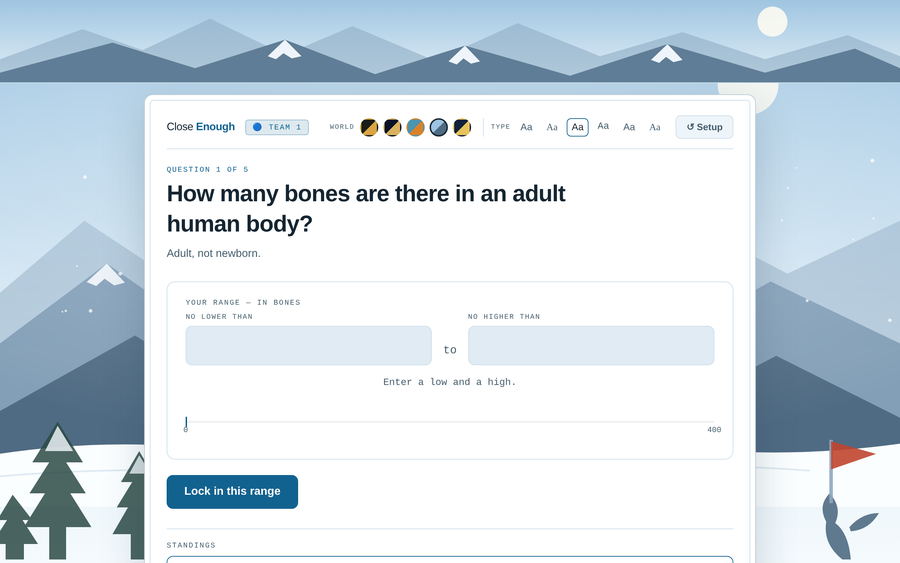
Every question has a real number as its answer, and you don’t give the number — you give a range you believe it falls inside. A narrow range that contains the answer scores well; a wide one scores little; a range that misses scores nothing however narrow it was. Covering the whole scale is worth zero, so there is no safe answer. Six looks ship with it — the activity’s own, plus a beach, a card room, an arcade, a glasshouse and a summit, each drawn in the file itself with no images to load. Switch mid-session from the masthead; a saved copy keeps the one you chose.
- Problem
- Nobody in operations knows the exact number. What separates people is whether they know how much they don’t know. “Between 40 and 60” from someone genuinely uncertain is a better answer than a flat “50” — and no quiz format can tell those two apart.
- Who it helps
- Anyone who has to plan, forecast, or set expectations — supervisors sizing a workload, trainers estimating ramp time, teams committing to a number they will be held to.
- In training
- The misses matter more than the scores. A range that missed entirely means the room was confident about something it had wrong, which is a different problem from guessing badly, and the closing screen counts them for you.
- Skills shown
- Calibration scoring with a quadratic width penalty, range input with live preview, scale visualisation, assessment design, in-browser editing with persistent export.
How to edit
- Click Edit this activity in the corner.
- Each question needs a real answer, a unit, and a floor and ceiling — the scale the range is measured against.
- The floor and ceiling matter more than they look: they set how much a wide range costs. Too generous and everything scores well.
- The why is where the teaching sits. Say which direction people usually guess wrong and what causes it.
- Click Save my version for a copy with your questions built in.