Case by Case
Twenty-six sealed cases, from one cent to a million dollars. Choose the case you are keeping before anything else happens — it stays shut to the end — then open the others in falling batches of six, five, four, three, two and then one at a time. Between rounds the house calls with an offer to buy your case back, derived from the mean of everything still sealed and bent by a temperament rolled fresh each game: how generous it is, how hard it reacts to a big case leaving, how much it tightens late. Two money boards flank the stage and strike through every amount as it goes. When three cases are left the stage changes for the Three-Case Showdown, and after the final call it comes down to keeping your case or switching to the last one on the floor. A two-team mode plays the same board twice, one team after the other, and ends on a standings screen.
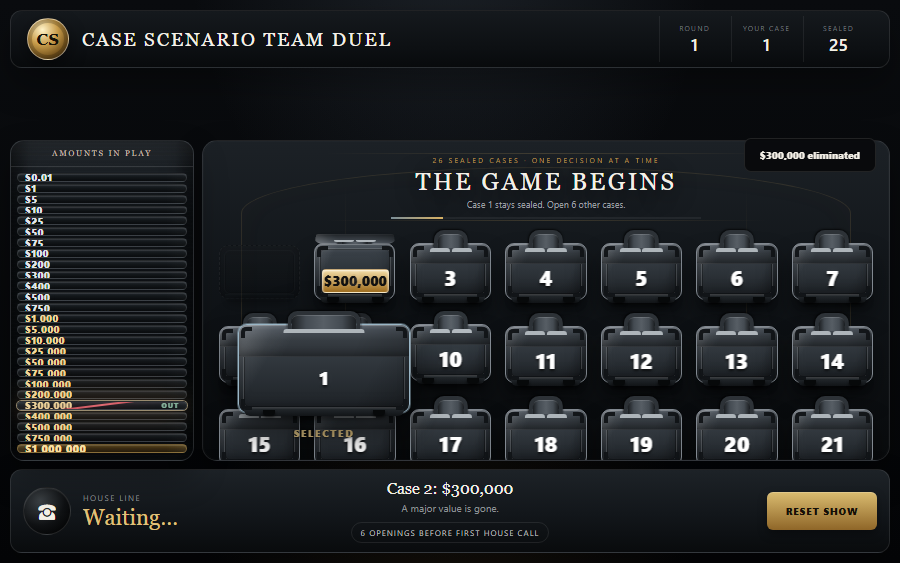
- Problem
- Expected value is easy to state and almost impossible to feel. A room can be shown that the offer sits below the average of what is still sealed, agree that it does, and take it anyway — which is not a failure of arithmetic but a preference about risk that nobody has been asked to say out loud.
- Who it helps
- Facilitators teaching decision-making, risk appetite and expected value — one volunteer at the front, or two teams playing the same board and comparing what each was willing to hold out for.
- In training
- Make the room decide rather than one person, and take the vote before the house calls. The offer arrives on a modal with a short loader, which is the window to ask what they would need to see to walk away. Two teams playing in turn is the sharpest version: the second team is dealt a different arrangement of the same twenty-six values, so the comparison is about nerve rather than luck. Push back hard on “we should have refused” in the debrief — a decision is good or bad before the case is opened, and holding a room to that distinction is worth more than the game is.
- Skills shown
- Game-show format design, a derived offer curve with a per-game bank temperament, staged reveals with held beats, a distinct three-case endgame, two-team turn-taking layered over a single-player build without rewriting it.
How to edit
- Open the file in any text editor — it is one self-contained HTML file with no build step and no server.
- Near the top of the script, values is the twenty-six amounts on the board, smallest to largest. Change them and both money boards, the strike-throughs and every offer follow.
- roundSchedule is how many cases open before each call: [6,5,4,3,2,1,1,1,1]. It must total one fewer than the number of cases, because your own case is never opened.
- createBankProfile holds the house’s temperament — generosity, volatility, late pressure and mood. Widen the ranges for a wilder house, narrow them for a fairer one.
- The two team names are editable on the setup screen and again on the duel bar during play; nothing needs editing in the file to change them.
- Save and open it. The mode picker asks for one player or two teams, and the setup screen takes the names.