Banker’s Offer
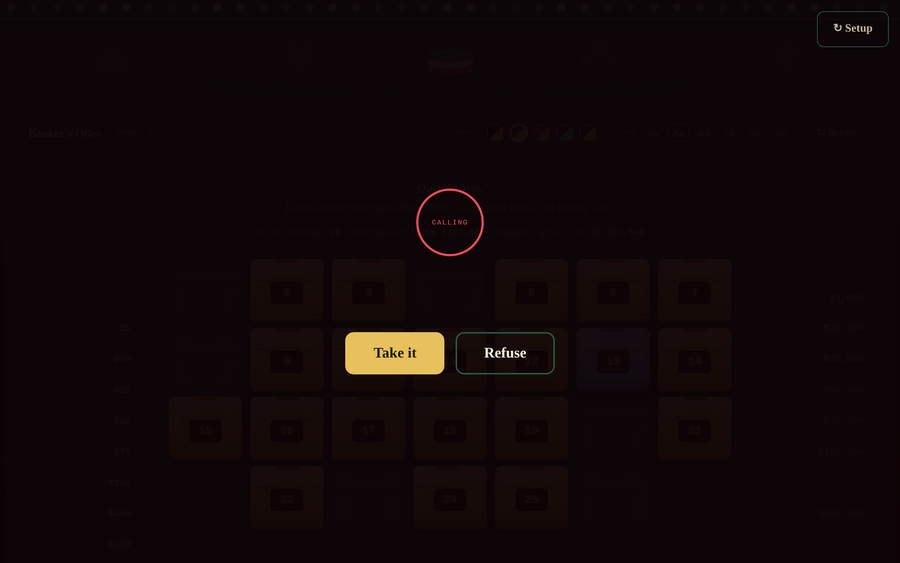
Twenty-six sealed cases, from one cent to a million. Choose the case you are keeping before anything else happens — it stays shut until the very end — then open the others a few at a time, each one a number that is not in yours. Then the banker calls. The offer is honest arithmetic and the screen shows you the sum it is derived from: the mean of everything still unknown, times a factor that starts low and climbs toward fair value as the game shortens. Early on you are being bought cheap because you still have information you have not used. Two boards flank the floor and strike through every amount as it leaves play, and the debrief compares what was taken against what was in the case and against every offer that was refused. Five looks ship with it — the activity’s own, plus a card room, an assembly hall, an arcade and a winter market, drawn in the file itself with no images to load.
- Problem
- Expected value is easy to explain and almost impossible to feel. A room can be told the offer is below the average of what is left, see the number proving it, and take the offer anyway — and that is not a failure of understanding, it is a preference about risk that nobody has ever asked them to say out loud.
- Who it helps
- Facilitators teaching decision-making and risk judgment — one contestant under pressure or two teams competing for the better read.
- In training
- Vote on every decision. One person deciding is a game; a room deciding is an argument worth having, and the argument is the activity. The average of what is left is on screen the whole time, so nobody can claim afterwards that they did not know — which makes the debrief about preference rather than arithmetic. Push back on “we should have refused”: a decision is good or bad before the reveal, not after it, and getting a room to hold that distinction is worth more than the game.
- Skills shown
- Game-show format design, derived offer curves with a configurable banker, staged reveal and held-beat pacing, live expected-value display, in-browser editing with persistent export.
How to edit
- Click Edit this activity in the corner.
- Values is the list of amounts in the cases. Any length works \u2014 the grid and both side boards lay themselves out from it.
- Rounds is how many cases open before each call. They must total one fewer than the number of cases, because your case is never opened; the tool warns in the console if they do not.
- Twenty-six is the classic shape for a reason: enough cases that the early rounds feel safe, few enough that the last three are unbearable.
- The banker\u2019s lines are chosen by how the round actually went, not at random. Keep them short \u2014 the number is doing the work.
- Currency is a prefix. Change it and everything reformats.
- Click Save my version for a copy with your boards built in.